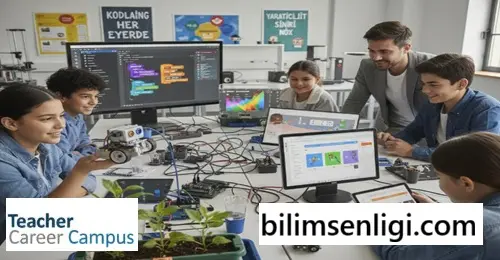
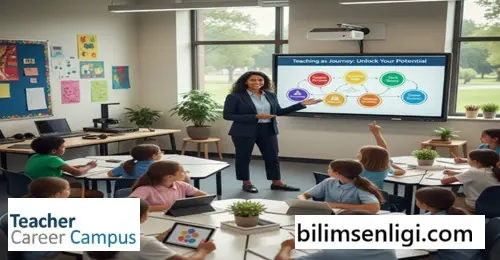
STEM education, which integrates the disciplines of Science, Technology, Engineering, and Mathematics, is not just about the transfer of academic knowledge; it also aims to raise students as creative and critical thinkers capable of solving the complex problems of the 21st century. In realizing this vision, the connection between theoretical knowledge and practice is of crucial importance. This is where the strategy of “Bringing STEM Careers into the Classroom” comes into play. The two most powerful tools of this strategy are role models (guest speakers) and field trips (site visits).
In the world of education, no matter how often the emphasis is placed on linking a subject to “real life,” transforming the abstract concepts in the STEM field into tangible, visible professions is an action that fundamentally alters students’ curiosity and motivation.
1. Transforming Abstract Knowledge into a Concrete Future
The core importance of bringing STEM careers into the classroom is to enable students to see concretely where the formulas, rules, and experiments they read in textbooks lead. When a student personally observes how integral calculus is used in the design of a bridge, or how genetic information in biology translates into a life-saving treatment at a pharmaceutical company, the learning reaches its purpose.
A. The Power of Role Models
Role models are living proof that allows students to say, “I can do this too!”
Identity Development and Sense of Belonging: Role models are especially effective in boosting interest in STEM fields among female students, students from minority groups, and students from socioeconomically disadvantaged backgrounds. Seeing a successful scientist, engineer, or programmer who shares their background or demographic characteristics gives them a sense of belonging to that career trajectory. If a student sees a Black female engineer working on the design of a rocket, this becomes a powerful impetus for that student to imagine their own potential.
Humanization and Breaking Stereotypes: STEM fields are often perceived as boring or antisocial professions that can only be pursued by “geniuses” with high IQs or “nerds.” When a successful professional comes and talks not only about their job but also about their hobbies, daily life, and the challenges in their work, this breaks down these stereotypes. Role models show that STEM professionals are also social people who require communication skills, teamwork, and creativity.
Realistic Perspective: Role models explain that the path to success is not always straight, and that failures and mistakes are also part of the learning process. This honesty reduces the pressure of perfectionism on students and encourages them to try and to make mistakes.
B. The Impact of Field Trips (Site Visits)
If role models bring the career into the classroom, field trips take students directly to the place where the career happens.
Context and Application: Visiting a factory, a research laboratory, a hospital, or a technology center immediately places the knowledge learned in the classroom into its context. When students personally see the movement of an industrial robot or the working principle of a genetic research device, the principles of physics, mathematics, and engineering behind these machines provide an instant moment of clarity.
Observing Teamwork: Science and engineering are rarely solitary efforts. On field trips, students see how people from different areas of expertise (engineer, technician, marketer, data analyst) collaborate on a common project, how they communicate with each other, and how they integrate different disciplines to solve complex problems. This is a practical example of teamwork, one of the 21st-century skills.
Current State of Technology: No matter how well-equipped school laboratories are, it is difficult to replicate the latest technology used in the industry. Field trips allow students to see the most current applications of artificial intelligence, automation, biotechnology, or advanced materials science. This helps students shape their future career plans and understand which skills they should invest in.
2. Critical Turning Points and Call to Action
Students’ interest in STEM careers often reaches a critical turning point during the middle and high school years. Decisions made during this period (elective courses, university preparation area) determine their future trajectory. Role models and field trips are the most effective interventions to inspire students and enable them to make informed choices at these crucial moments.
Inclusive and Accessible Programs: The benefits of these activities must reach the students who need them the most. Schools should direct career visits and role model invitations not only to the highest-performing students but also to those who are distant from STEM fields, appear uninterested, or have not yet discovered their potential. Digital solutions, such as virtual field trips or bringing professionals from remote regions into the classroom via video conferencing, can also be used to overcome transportation barriers.
Teacher Training: Teachers are the key people who will build the bridge between role models and students. It is important that teachers are knowledgeable about the industrial applications of their disciplines and possess the guidance skills that enable them to link the visitors’ discourse with the curriculum in a meaningful way.
Conclusion: Building a Culture
Bringing STEM careers into the classroom should not be a one-time event; it should be part of the educational philosophy and culture of the school. Role models and field trips do not merely provide students with information about professions; they also instill in them the courage to question, the perseverance to solve problems, and the responsibility to find solutions to global problems through science. These concrete experiences, by giving meaning to abstract knowledge, are the most vital way to nurture the next generation of scientists, engineers, and technology leaders. In this way, the foundations of the future innovation ecosystem are laid in the school desks.